When a health department reviews a self-serve ramen station, it usually asks for four things about the machine: a spec sheet, proof of sanitation and electrical safety listing, cleaning instructions, and details on water and power. For the NEO CUCINA Pro, we can send all four. What your inspector decides about your sinks, your toppings and your permit is up to them, so bring the documents early and ask.
This is one of the most common questions in our inbox. Buyers write things like "Can you send me a spec sheet for the health department?" and "I'm in the middle of an inspection and need a Spec Sheet or Cut Sheet for this machine." Below is the full document pack, what each document answers, and the questions inspectors tend to raise about the rest of the station.
The document pack we send
Every document below names the exact model, NC-RCP1H, which is what reviewers check first.
| Document | What it answers | Who usually asks |
|---|---|---|
| Spec sheet (110V) | Size, weight, voltage, wattage, plug type, water connection and inlet pressure | Plan reviewers, landlords, mall or property managers |
| ETL Sanitation certificate | That the machine is listed for sanitation as food equipment, not only for electrical safety | Environmental health and plan review |
| ETL Safety certificate | Electrical safety listing for the machine | Inspectors, electricians, property managers |
| User manual, Maintenance and Care section | Daily cleaning, descaling and how the machine is cared for in commercial use | Inspectors who want your cleaning procedure |
Ask for the pack before your plan review meeting, not after. Other operators have used these same documents for their local health department reviews. You can forward our email straight to the reviewer, and if the reviewer has a follow-up question about the machine, we answer it.
The key numbers inspectors look for
Most of these come straight off the spec sheet. Having them in one place saves a round trip.
- Model: NEO CUCINA Pro, NC-RCP1H
- Power: 110 to 120V, 60Hz, 1350W, standard NEMA 5-15P plug
- Size: 9.5 x 16.5 x 18.9 in, 13.9 lb, countertop
- Water: runs from a water jug or a direct water line; inlet pressure 7 to 58 psi; about 15 fl oz (450 ml) per bowl
- Cooking: induction plate heats the bowl itself; food sits in a single-use paper bowl or your own induction cookware, not inside the machine
- Safety features: overheat shutoff, container detection, automatic stop when cooking finishes
That last point matters in a review. The noodles and broth never pass through the machine's water system. The machine heats water and the bowl, and the food stays in the bowl the customer throws away. Each machine also carries its certification label on the body, so an inspector can match the model on site.
What a station looks like to an inspector
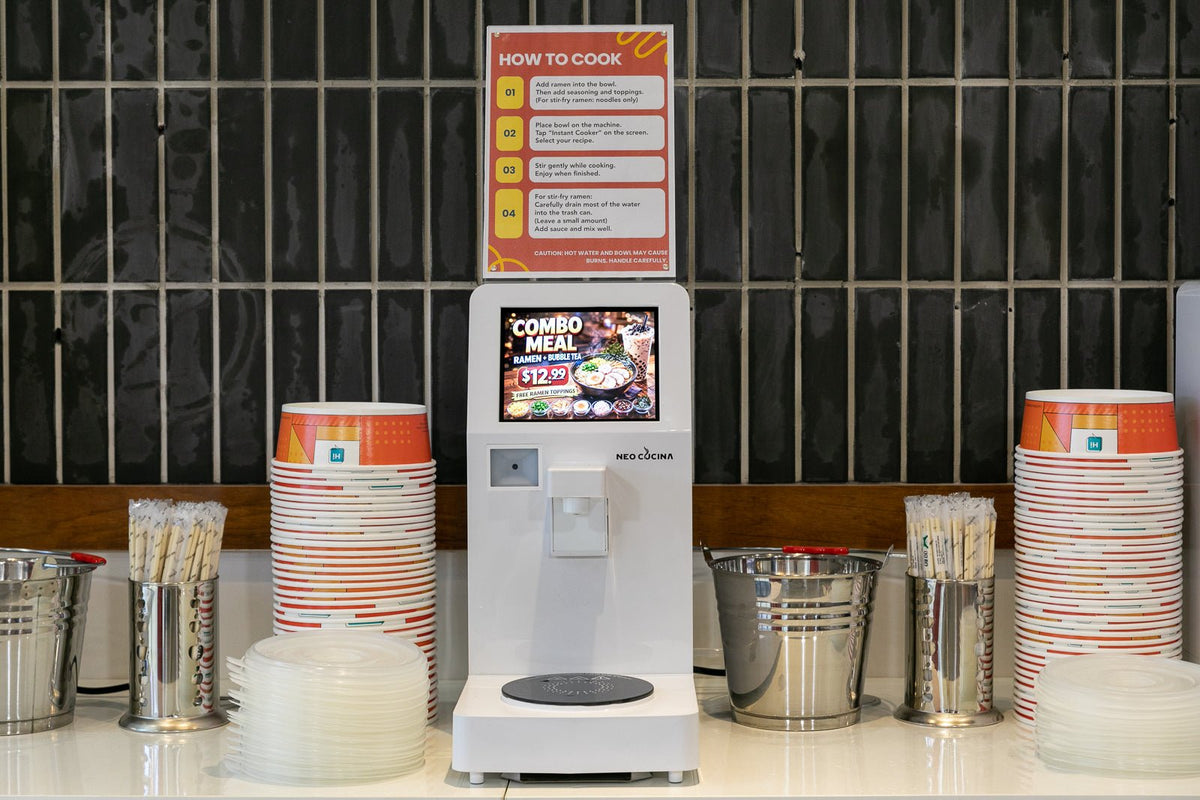
The machine is usually the easy part of the review. The questions tend to be about what is around it. At Kanku's, a grocery store inside a gas station in Chattanooga, TN, the station is built from parts an inspector can see at a glance: packaged ramen on a rack, sealed sauces in a caddy, cold toppings in a refrigerated case with labeled bins, single-use bowls, utensils and a trash bin.
Before your meeting, write down how your station will work:
- Which foods are packaged and shelf-stable, and which need refrigeration
- Where cold toppings are stored and how you check their temperature
- Who wipes the machine and counter, and how often
- Where customers throw away bowls, broth and packaging
- Whether the machine runs from a jug or a water line
A station with only packaged noodles and dry toppings is a different conversation from one with fresh eggs and sliced meat. Your inspector will tell you what your local code requires for each. See our food safety guide for self-serve ramen stations for the operator side of this.
What the documents do not decide
Certificates describe the machine. They do not approve your location. Buyers often ask us whether they will need a hand sink, a three-compartment sink or a food permit. Those answers depend on your county or city rules, your menu and your building, and only your local health department can give them. What we can do is make sure they have every fact about the equipment they need to decide.
For more on what ETL listing does and does not cover, read ETL certification and commercial food equipment compliance.
A simple order of steps
- Request the document pack from our support team, before you buy if you like.
- Call or email your local health department and ask what they need for a countertop cooking appliance and a self-serve station.
- Send them the spec sheet and both ETL certificates, plus your station plan from the list above.
- Ask them directly about sinks, toppings and permits for your menu.
- Plan power and water using the power, water, Wi-Fi and counter space guide.
Frequently asked questions
Is the machine listed for sanitation, or only for electrical safety?
Both. The Pro has an ETL Sanitation certificate and a separate ETL Safety certificate. Both name the model NC-RCP1H. Send both, because some reviewers only see the electrical listing and assume that is all there is.
Does the machine have a certification label on it?
Yes. The label is attached to the body of each machine, so an inspector can check it against the certificate on site.
Do I need plumbing for the inspection?
The Pro does not need a plumbed connection. It runs from a standard water jug, and a direct line is optional. See water jug vs. direct line.
Do I need a hand sink near the machine?
Your health department decides that, based on your local code and what you serve. Ask them when you send the documents, and mention whether your toppings are packaged or fresh.
Can you tell me what my city requires?
We cannot tell you what your local rules are. We can send every document about the machine and answer your reviewer's equipment questions.
See NEO CUCINA Pro specs and pricing or request the health department document pack from our support team.
Share:
How Li's Buffet Replaced Its Sushi Station with a Self-Serve Ramen Bar