Every time we show an automatic ramen cooker, someone asks: “Why not just use a microwave or an electric kettle?” It is a fair question.
For one occasional bowl at home, use the appliance you already have. But judging these options only by whether the noodles eventually become hot misses the biggest difference: hot noodles and properly boiled noodles are not the same thing.
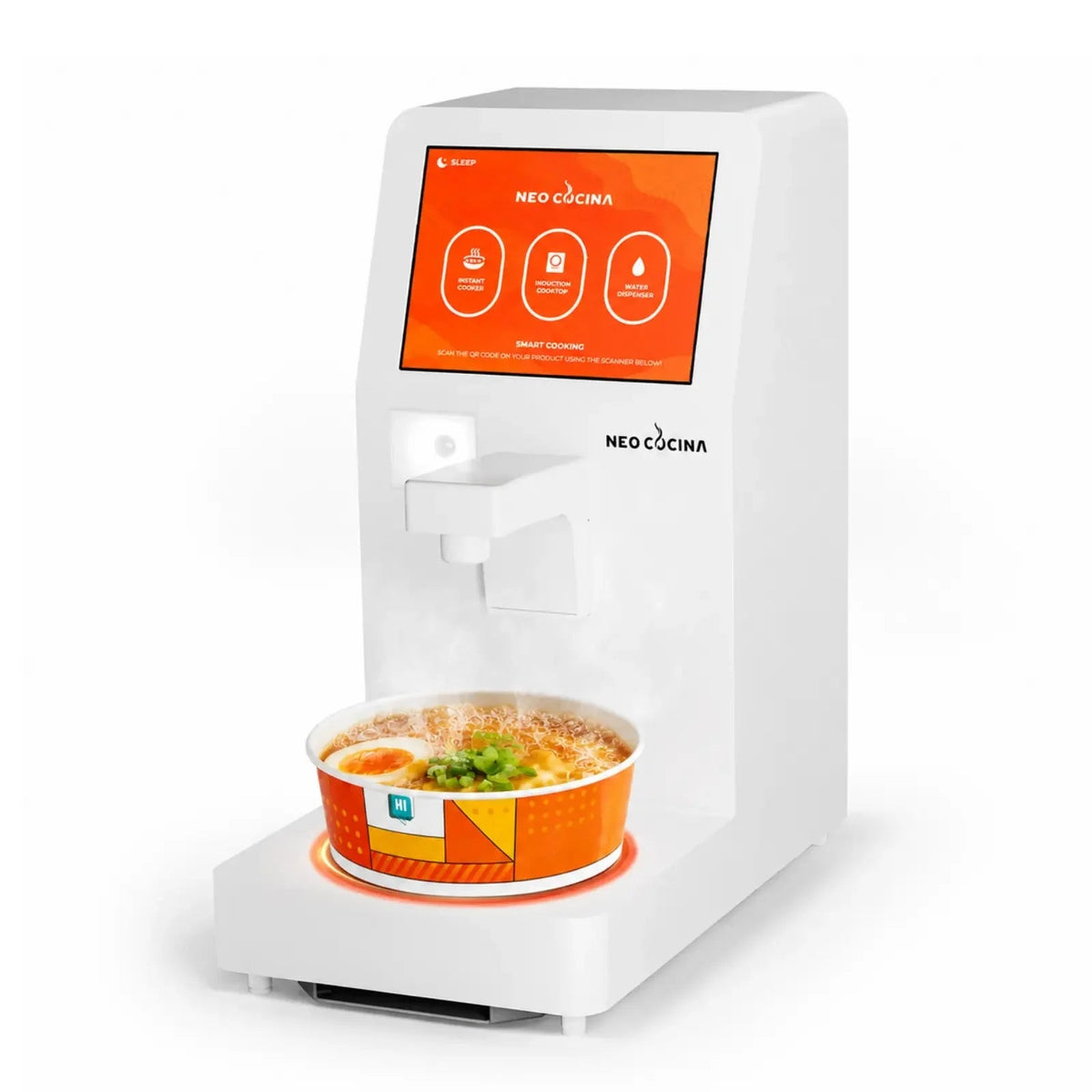
A kettle pours hot water over the noodles and leaves them to soak. A microwave can cook ramen, but the usual microwave method does not reproduce the same controlled, continuous boil as a pot on the stove. An automatic ramen cooker uses induction heat to keep the bowl actively boiling through the cooking cycle. The noodles are cooked in boiling water, not merely softened or reheated.
That difference shows up in the final bowl: more even texture, better-separated noodles, a springier bite, and broth that stays properly hot. For a business selling ramen, food quality comes first. Automatic water dispensing, repeatable programs, and easier self-service are additional advantages.
Here is the practical difference between the three options.
What an Electric Kettle Can and Cannot Do
An electric kettle heats water. A commercial hot water dispenser performs essentially the same job at a larger scale.
That works well for:
- Tea, coffee, and powdered drinks
- Instant soup and oatmeal designed for hot-water preparation
- Cup noodles specifically made to soften by soaking
For occasional cup noodles, a kettle may be enough. But it does not continue heating the bowl. As the noodles absorb heat, the water cools, and products intended to be boiled can end up soft outside, firm in the center, or unevenly hydrated. A kettle provides hot water; it cannot maintain the boil that many bagged ramen products are designed for.
Can a Microwave Cook Ramen?
Yes. With a microwave-safe bowl, the correct water level, and enough time, a microwave can cook ramen. It is a sensible, general-purpose option for a home, dorm room, or low-traffic employee break room.
But microwave heating is not the same as cooking noodles in continuously boiling water. The result is more sensitive to the microwave’s power, bowl shape, water level, cooking time, and where the noodles sit. That can mean hot spots, clumping, or a softer, less springy texture.
The tradeoff is that the user manages nearly every step:
- Find a microwave-safe bowl
- Add the right amount of water
- Choose the cooking time and power
- Pause or stir when necessary
- Handle boil-overs and splashes
- Check the noodles and clean afterward
Those steps are manageable for one person. In repeated or customer-facing use, they create variation: too little water, the wrong time, uneven stirring, or broth left splattered inside. A microwave can cook ramen; it was not designed to reproduce a pot-style boil or guide different users through a repeatable ramen workflow.
What an Automatic Ramen Cooker Does Differently
An automatic ramen cooker combines water dispensing with induction heating. Instead of asking the user to measure the water and set the time, the machine can run a saved program:
- Place an induction-compatible bowl or pot on the heating area.
- Select a preset or, on supported models, scan the ramen package.
- The machine adds the programmed amount of water.
- Induction heat brings the bowl to a boil and continues through the cooking cycle.
- Give the noodles a quick stir during cooking when needed.
- The machine stops automatically when the program finishes.
The induction surface keeps transferring heat into the bowl after the water is added, so the noodles continue cooking in actively boiling water. That is the main difference. Reducing the decisions required for each bowl is valuable, but it comes after the taste and texture of the food.
The Biggest Difference Is in the Bowl, Not the Button
Automation makes a ramen station easier to operate, but the reason to cook instead of merely soaking or microwaving the noodles is the result customers eat.
In an active boil, water moves around the noodles as they hydrate and cook. With a quick stir, the strands separate and cook more evenly, creating a springier bite instead of noodles that are firm in some places and overly soft in others.
Because the bowl remains hot, seasoning dissolves while the noodles cook, and toppings warm without cooling freshly dispensed water. The broth stays hotter and the finished bowl tastes more like a freshly cooked meal. A kettle boils water; a microwave heats food; a ramen cooker is designed to keep the ramen itself boiling.
Side-by-Side Comparison
| Consideration | Electric Kettle / Hot Water Dispenser | Microwave | Automatic Ramen Cooker |
|---|---|---|---|
| Main function | Provides hot water | Heats food and water | Dispenses water and cooks ramen |
| Cooking action | Soaks noodles after dispensing | Heats and cooks in a microwave-safe bowl | Maintains an active induction boil |
| Typical noodle texture | Can hydrate unevenly if the product requires boiling | Varies with power, bowl, time, and water level | More even, springy, and closer to stovetop ramen |
| Broth temperature | Starts falling after water is poured | Can heat unevenly | Stays hot throughout the cooking cycle |
| Water measurement | Manual | Manual | Can be programmed |
| Cooking time | User watches the wait time | User selects the time | Saved program stops automatically |
| Best noodle formats | Cups designed for hot water | Microwave-safe recipes | Packaged ramen and other boil-in-bowl foods |
| Customer self-service | Simple, but product-dependent | Familiar, but highly manual | Guided and repeatable |
| Cleanup | Cup or bowl | Bowl plus possible interior splashes | Disposable bowl or reusable pot |
| Other uses | Drinks and instant foods | General food reheating | Hot water and induction cooking |
| Best fit | Beverage station or occasional cup noodles | Home or low-frequency break room | Repeated, customer-facing, or commercial ramen service |
Is It About Speed? No. It Is About the Result
An automatic ramen cooker is not necessarily faster for a single bowl. A microwave, kettle, and ramen cooker can all prepare certain noodles within a few minutes.
The stronger reason to choose a ramen cooker is that it actively boils the noodles and produces a more convincing freshly cooked result. After that, the programmed water and cooking cycle make the process easier to repeat. For a business, better food and fewer user decisions matter more than saving a few seconds.
Which Option Makes Sense for Your Business?
Choose an electric kettle or hot water dispenser if:
- Tea, coffee, or other drinks are the main purpose.
- Ramen is only an occasional convenience.
- You offer cup noodles designed to be prepared with hot water.
Choose a microwave if:
- Ramen volume is low.
- The appliance is mainly for employees rather than paying customers.
- General food reheating matters more than a specialized ramen workflow.
Choose an automatic ramen cooker if:
- The taste and texture of freshly boiled ramen matter to the product you serve.
- Ramen is a product you sell or a visible part of the customer experience.
- You want to use packaged noodles that are normally boiled rather than soaked.
- Customers or entry-level employees will operate the station.
- You want one machine for ramen cooking, instant hot water, and induction heating.
If your business makes two bowls a week, a dedicated ramen cooker is probably unnecessary. If customers make bowls throughout the day, or if you want the food to taste cooked rather than merely heated or soaked, a microwave or kettle may cost less upfront but deliver a weaker product and a less controlled process.
Choosing Between NEO CUCINA Studio and Pro
Both NEO CUCINA models actively boil noodles with induction and also function as instant hot water dispensers. The difference is how much automation and management the operation needs.
NEO CUCINA Studio: A Simpler Countertop Setup
The NEO CUCINA Studio is designed for offices, break rooms, kitchens, and smaller shops. It includes three one-touch cooking presets, adjustable hot-water settings, and a removable one-gallon tank with an optional direct-line connection.
Everything is controlled on the machine, so there is no app, account, or Wi-Fi setup. Studio is the better fit when you want a compact ramen cooker and hot water dispenser without remote management.
NEO CUCINA Pro: Built for Customer-Facing Operations
The NEO CUCINA Pro adds an 8-inch touchscreen, editable presets, barcode-based cooking programs for supported ramen products, and a web dashboard for connected management.
Pro can also work as an induction cooktop. Place a small pot that works on induction over the cooking area and use it to boil soup, cook dumplings, heat broth, or prepare other foods that need continuous heat. That is another practical difference from a kettle or microwave: the Pro can keep food at a real boil and actually cook it, rather than only adding hot water or reheating it.
It can draw water from an external jug or connect to a direct water line. Core cooking and hot-water functions work offline, while barcode, cloud-menu, and remote-management features use Wi-Fi. Pro is the stronger choice for a self-serve ramen station or a business that wants more control over the customer interface and cooking programs.
What About the Bowl?
Induction cooking requires an induction-compatible bowl or pot. A regular paper soup bowl will not heat just because it is placed on the cooking surface.
NEO CUCINA induction paper bowls let the operator cook and serve in the same 42-ounce disposable bowl. That removes the pot-washing step between customers. Induction-compatible metal cookware can also be used when reusable pots make more sense.
Frequently Asked Questions
Does ramen taste better from a ramen cooker than a microwave?
The cooking method can make a noticeable difference. A ramen cooker applies induction heat to the bowl and maintains an active boil, helping the noodles cook more evenly and retain a springier texture while the broth stays hot. A microwave can cook noodles, but the outcome depends more heavily on the bowl, water level, cooking time, power setting, and user.
Can I just pour kettle water over any packaged ramen?
Not always. Cup noodles often include hot-water instructions, but many bagged noodles are formulated to be boiled. Check the package directions. If it calls for boiling on a stove, soaking it in kettle water may produce a different texture.
Does a ramen cooker replace a microwave?
No. A microwave is a general-purpose reheating appliance. A ramen cooker is specialized equipment for dispensing water and running repeatable boil-in-bowl cooking programs. A business may reasonably use both for different jobs.
Does the ramen cooker require plumbing?
Not necessarily. NEO CUCINA Studio can use its removable tank, while Pro can draw from an external water jug. Both models also offer a direct-line option when automatic refilling is preferred.
Is a ramen cooker worth buying?
It depends on frequency and purpose. For occasional personal use, a kettle or microwave is the rational choice. For repeated commercial or customer-facing use, the value starts with a better actively boiled bowl, then extends to automatic water dispensing, repeatable programs, and a more purpose-built self-service experience.
The Bottom Line
The commenters are right about one thing: you do not need a dedicated ramen cooker to make one bowl of noodles.
But the comparison should not stop at whether the noodles become hot. A kettle softens noodles by soaking them. A microwave can cook them, but the result varies with the appliance, bowl, water, timing, and user. An automatic ramen cooker keeps the bowl at a real boil, producing noodles with a more even, springy texture and a finished bowl closer to stovetop ramen.
Choose a kettle for hot water and simple cup noodles. Choose a microwave for occasional, general-purpose use. Choose an automatic ramen cooker when the taste and texture of properly boiled ramen justify dedicated equipment. Repeatable programs, customer self-service, and a cleaner commercial setup strengthen the business case.
For a compact, locally controlled setup, explore NEO CUCINA Studio. For a customer-facing station with barcode cooking and connected management, explore NEO CUCINA Pro.
Share:
What Your Ramen Station Dashboard Data Can Tell You
NEO CUCINA Pro vs. Studio: Which Automatic Ramen Cooker Fits Your Location?